
I.The Basics
A. Matter anything occupies space and has mass
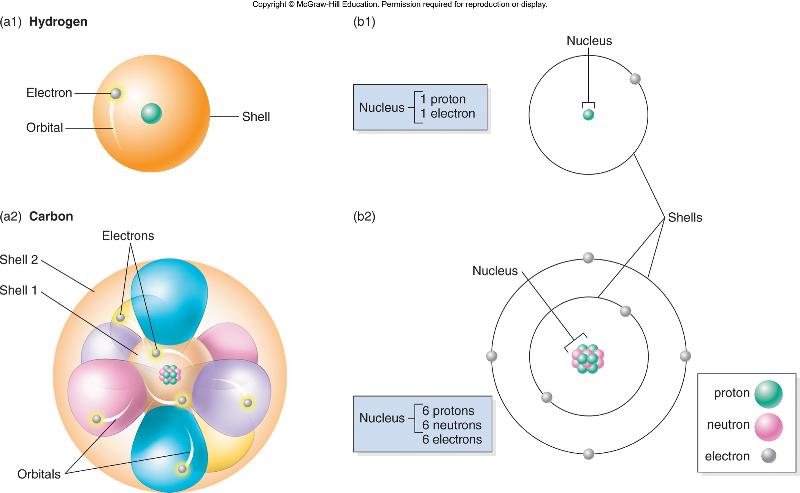
1. atoms - smallest unit of element indivisible by chemical means composed of subatomic particles.
a. protons positively charged particles, contained within the nucleus and have a mass of 1 atomic mass unit (amu)
-The number of protons is know as the atomic number and is constant for that element.
– also contained in nucleus , but with no charge. Neutrons have a mass of 1amu.
for all practical purposes the ATOMIC MASS of an element is the sum of the number of protons and the number of neutrons.
- ISOTOPE - alternative form of element - different mass than the major components of an element.
Since the number of protons is constant isotopes must differ in number of neutrons.
c.Electrons - negatively charged particles that orbit the nucleus in "orbitals" For our purposes their mass is negligible
IONS - atoms or molecules with a charge
CATIONS - positively charged
ANIONS - negatively charged
II.Electrons and the formation of chemical bonds
A. Bond - an association between 2 or more atoms
1. Ionic bond - bond formed when one atom completely donates an electron to another atom.
Ex- NaCl (Sodium Chloride )

2. Covalent bond- bond formed when atoms share electrons to achieve stability in the outer shell
a. non-polar covalent bond - equal electron sharing to achieve stability in the outermost orbital.

b. polar covalent bonds unequal electron sharing
1.) occurs with highly electronegative elements - that is elements thathave a high affinity forelectrons -- there are a number of them but in biology Nitrogen and Oxygen are of greatest concern. Mneumonic device "Just Say NO"
EX - water

Water is:
1. Most abundant molecule in living organisms- 50 – 95% weight of living things
2.Absolute requirement for life (as we know it)
3. Water forms hydrogen bonds which are not a true bond but weak associations between 2 temporary dipoles (partial charges)
on adjacent polar molecules


B. Properties of water due to H bonding
1.Surface tension – Examples include: drop from a faucet, beading up over rim of a glass, floating a needle. Or this "Jesus Lizard"
striding across the water
a.adhesion of water – it is attracted to and clings tightly to other charged materials
b.cohesive -- sticks together – individual water molecules are attracted to each other by opposite charges
2.Capillary action and Imbibition
a. adhesion and cohesion at work again! Capillary action describes water moving upperward as a small glass tube is inserted into the water. Class is polar and the water molecules are attracted to the glass (adhesion) but at the same time the water molecules are attracted to other water molecules pulling them slightly up the tube.
3. Resistant to temperature change
a. high specific heat –
2.) water- about 2x the amount of energy require to heat 1 gram of alcohol or oil
a. heat – increases the kinetic energy of water – merely increases the rate at which hydrogen bonds are broken
and reformed
b. allows life at a relatively stable temperature
c. high heat of vaporization – The temperature at which at liquid is converted to a gas. Water boils at 100oC at sea level.
60 times that of ether; twice that of ammonia neither of these compounds contain hydrogen bonds
d. freezing – all molecules simultaneously form H bonds -expands and becomes less dense
1). It floats allowing seasonal thaws
2). Pipes break
4. Solvent properties – "universal solvent"
a. polarity of water tends to separate ionic components
b. many important molecules – such as sugar – are polar too therefore they are water soluble of Hydrophilic.
Those molecules that are non polar are not soluble in water and are termed hydrophobic
"LIKE DISSOLVES LIKE"

THE PH SCALE
5. Ionization of water –
a. acid – a substance that donates H+
b. base – substance that accepts H+
c. buffer – a substance that resists pH change
d. the PH scal
pH = -log of the concentration of H
acid pHs are from 0 - 6.999 They have high concetrations of H+. As pH increases the amount of H+ decreases as the H+ are replaced by OH-
The log function indicates that each pH unit represents a ten fold change in the concentration of H+
A solution with a pH of 2 has 10X more hydrogen ions than a solution with a ph of 3
At pH 7 the concentration of H+ = the concentration of OH-
Alkaline solutions are pHs from just above 7 to 14
Try this quiz question

III. Basic types of chemical reactions
1. Synthesis reaction - 2 or more smaller components --> entirely new larger component.
a -OH + H-b --> a-b + water
This type of reaction can be known as:
a. dehydration (condensation) synthesis reactions- 2 components are joined and split out a water molecule
b. in terms of metabolism these are called anabolic reactions - require external Energy input polysaccharides, carbohydrates, and polypeptides are synthesized by this type of reaction
2. Decomposition reaction- breakdown reactions - reverse of synthesis - large molecules are cleaved to there smaller components
a.these reactions are also called hydrolysis reactions- because they break apart a large molecule by inserting a water molecule
a-b + H2O --> a-OH + H-b
breakdown of most biological molecules is accomplished by hydrolytic reactions
3. Oxidation-reduction reaction - there's really not much new here, we just keep track of electrons
Losing electrons is oxidation
Gaining electrons is reduction
Since electrons are matter and matter cannot be created or destroyed, oxidation must always be accompanied by reduction
oxidation reduction reactions are used to break down food stuffs to generate cellular energy (ATP - adenosine triphosphate)
