Chapter #6 Nutrition & Growth
I. Nutrition
process by which chemical substances (nutrients) are acquired from the environment and used in cellular activities
Essential nutrients – must be provided to an organism
Two categories of essential nutrients:
–Macronutrients – required in large quantities; play principal roles in cell structure and metabolism
•Proteins, carbohydrates
–Micronutrients or trace elements – required in small amounts; involved in enzyme function and maintenance of protein structure
•Manganese, zinc, nickel
•Organic nutrients – contain carbon and hydrogen atoms and are usually the products of living things
–Methane(CH4), carbohydrates, lipids, proteins, and nucleic acids
•Inorganic nutrients – atom or molecule that contains a combination of atoms other than carbon and hydrogen
–Metals and their salts (magnesium sulfate, ferric nitrate, sodium phosphate), gases (oxygen, carbon dioxide) and water
II. Energy Sources that Support Life
Requirements for Growth and Metabolism
2 broad groups based on the source of carbon
1. Autotrophs - utilize inorganic carbon (carbon dioxide
Photoautotrophs (photosynthesizers) use it directly to produce organic nutrients. Non photosynthetic organisms are therefore dependent upon those producers to provide them with organic nutrients. Chemoautotroph, organisms, typically derives energy from the oxidation of inorganic compounds.
2. Chemoheterotrophs an organism which derives its energy from organic chemicals, and needs to consume other organisms in order to live Photoheterorophs get energy from sunlight but require organic carbon
Sources of Essential Nutrients
Heterotrophs - Catabolize organic molecules -Sources extremely varied from simple to complex carbohydrates
•Fungi/protozoa … cellulose - think where you find toadstools growing
•Mycoplasmas… lacking cell walls need essential lipids for their cell membranes
•Some will use phenolics ( common disinfectants) and even organophosphates which may be important in bioremediation.
Saprobe (Saprophyte) an organism that obtains nutrients from dead decaying organisms.
Gas Requirements
|
Categories of Oxygen Requirement •Aerobe – utilizes oxygen and can detoxify it •Obligate aerobe – cannot grow without oxygen •Facultative anaerobe – utilizes oxygen but can also grow in its absence •Microaerophilic – requires only a small amount of oxygen •Anaerobe – does not utilize oxygen •Obligate anaerobe – lacks the enzymes to detoxify oxygen so cannot survive in an oxygen environment •Aerotolerant anaerobes – do not utilize oxygen but can survive and grow in its presence
|
|
Oxygen
•As oxygen is utilized it is transformed into several toxic products:
–Singlet oxygen (O2), superoxide ion (O2-), peroxide (H2O2), and hydroxyl radicals (OH-)
Aerobe - An organism that utilizes oxygen. This term is often prefix with the term "obligate" meaning the organism cannon live without oxygen.
•Most aerobic cells have developed enzymes that neutralize these chemicals such as superoxide dismutase, catalase, or peroxidase
•If a microbe is not capable of dealing with toxic oxygen, it is forced to live in oxygen free habitats
Obligate anaerobe - must live in and oxygen free environment
facultative anaerobe - can live with or without oxygen
areotolerant - anaerobic but can survive in an oxygen atmosphere
Nitrogen
•Main reservoir is nitrogen gas (N2); 79% of earth's atmosphere is N2.
•Nitrogen is part of the structure of amino acids, proteins, DNA, RNA & ATP – these are the primary source of N for heterotrophs.
•Some bacteria & algae use inorganic N nutrients (NO3-, NO2-, or NH3). Nitrate, Nitrite, Ammonia respectively
•Some bacteria can fix N2.
Regardless of how N enters the cell, it must be converted to NH3, the only form that can be combined with carbon to synthesis amino acids, etc
Prototrophs make all own nitrogenous compounds given a source of nitrate or ammonia
•Nitrogen fixation – nitrogen gas from the air converted into a biologically useful form such as nitrate, nitrite of ammonia
•Denitrification – conversion of nitrate, nitrite or ammonia to nitrogen gas. Denitrifying bacteria are found in notoriously poor, alkaline soils
Carbon Dioxide Requirement
All microbes require some carbon dioxide in their metabolism
•Capnophile – grows best at higher CO2 tensions than normally present in the atmosphere
Physical Requirements
Temperature - varies widely among habitats. Microbes exist at all points on a very wide temperature scale
|
|
|
|
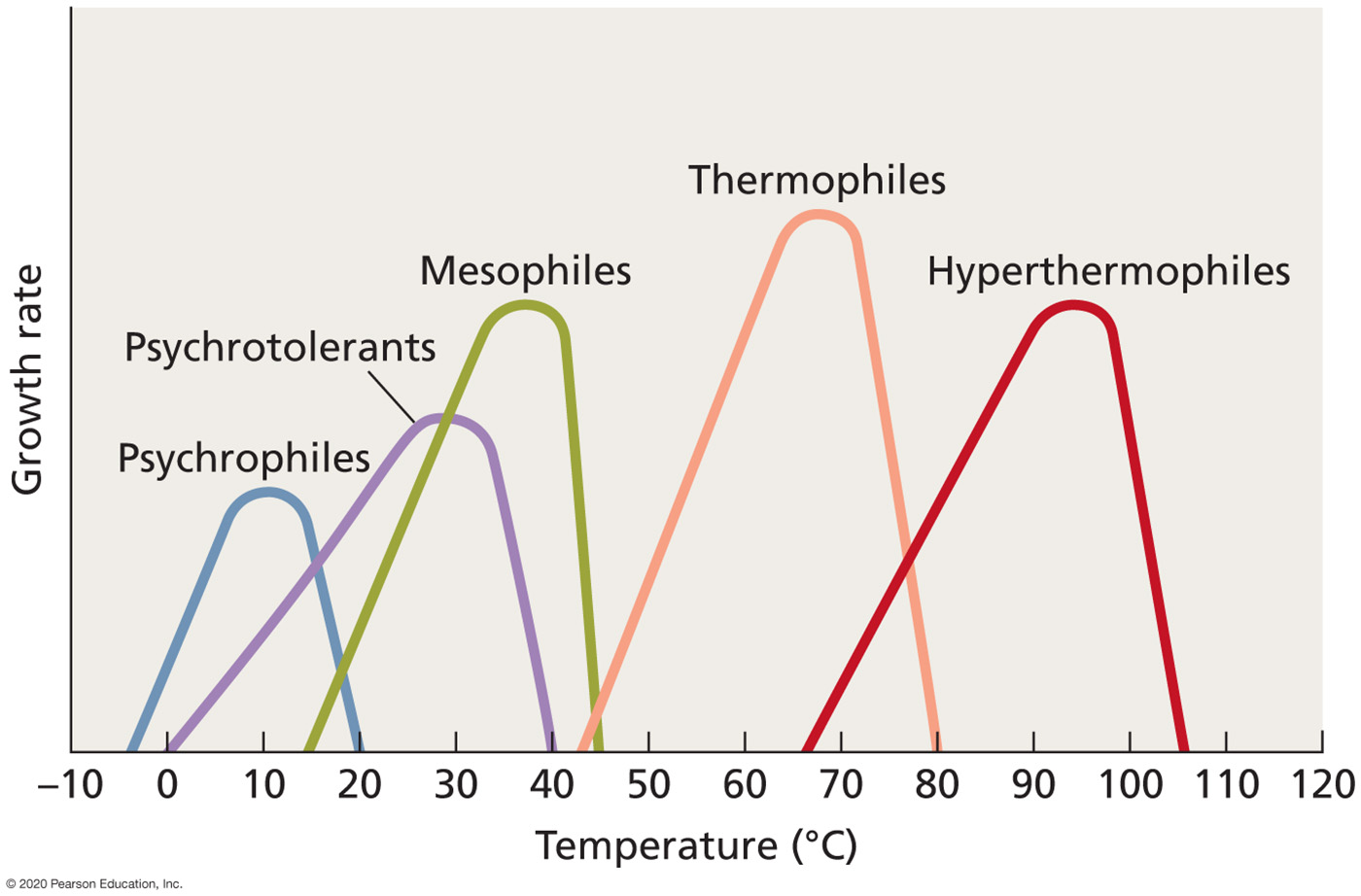
•3 Cardinal Temperatures •Minimum temperature – lowest temperature that permits a microbe's growth and metabolism Maximum temperature – highest temperature that permits a microbe's growth and metabolism Optimum temperature – promotes the fastest rate of growth and metabolism
|
Temperature Adaptation Groups Psychrophiles – optimum temperature below 15oC; capable of growth at 0oC Psychrotolerant - survives at cool temperatures Mesophiles – optimum temperature 20o- 40oC; most human pathogens Thermophiles – optimum temperature greater than 45oC Hyperthermophiles thrives in extremely hot environments—from 60 °C
|
pH
Although most life exists at or near neutrality, pH can vary extremely from habitat to habitat. Microbes are the most adaptable organisms with regard to pH. Neutrophiles - grow best near neutral ph ranges,; Acidophiles, - acidic habitats; Alkalinophiles - up to 11.5 ph
Osmotic pressure
Osmosis - diffusion of water across a membrane, driven by solute concentrations on each side of the member (covered in chapter 3). Review hypertonic and hypotonic. Halophiles are adapted to growth under high osmotic pressure or solute concentration. One such organism is Vibrio vulnifcus. See emerging Disease Case Study Page 170.
Biofilms (Review Chapter 3)
|
|
Biofilm- complex, synergistic relationship between numerous microorganisms often of different species. Discussed in chapter 3. See relationships below
Ecological Associations
•Symbiotic – two organisms live together in a close partnership
–Mutualism – obligatory, dependent; both members benefit
–Commensalism – commensal member benefits, other member neither harmed nor benefited
–Parasitism – parasite is dependent and benefits; host is harmed
•Non-symbiotic– organisms are free-living; relationships not required for survival
–Synergism – members cooperate to produce a result that none of them could do alone
–Antagonism – actions of one organism affect the success or survival of others in the same community (competition)
•Antibiosis
The Study of Microbial Growth
•Microbial growth occurs at two levels: growth at a cellular level with increase in size, and increase in population
•Division of bacterial cells occurs mainly through binary fission (transverse)
–Parent cell enlarges, duplicates its chromosome, and forms a central transverse septum dividing the cell into two daughter cells
Rate of Population Growth
•Time required for a complete fission cycle is called the generation, or doubling time
•Each new fission cycle increases the population by a factor of 2 – exponential growth
•Generation times vary from minutes to days
Logarhithmic Growth
|
|
|
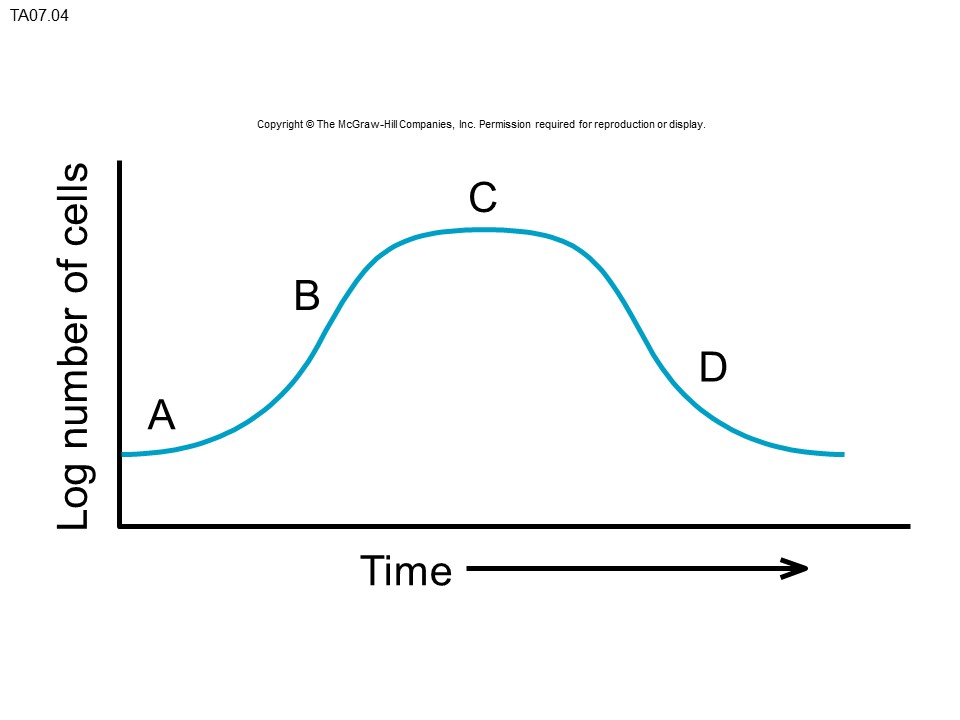
Lag Phase-numbers remain low as numbers build the microbes are conditioning their environment
Log Phase (Exponential phase) Period of rapid expansion of cell numbers.
Stationary Phase - rate of dividing cells is equal to the number of dying cells. Were this a human population we would say that natalité equals mortality
The environment has reached its carrying capacity... the number of organisms an environment can support
decline in nutrients and other resources
increasing wastes
Death Phase - as resources decline and wastes build up the organisms begin to die.
•Equation for calculating population size over time:
Nƒ = (Ni)2n
Nƒ is total number of cells in the population
Ni is starting number of cells
Exponent n denotes generation time
2n number of cells in that generation