Chapter 9 Controlling Microbial Growth in the Environment
|
|
*Important- you must know these terms!
I. Microbial Death is defined as the permanent loss of reproductive capacity under ideal environmental conditions. The Microbial Death rate is usually found to be constant over a period of time. Suppose a disinfectant claims it kills 90% of microbes, that means that under ideal conditions it should kill 90% in the first minute of exposure. If there were a billion, 100 million would be left. In the next minute the number would be reduce to 10 million. However, remember conditions are seldom ideal and cells that have greater resistance take even longer to kill.
SPECIAL CONSIDERATIONS - the time it takes to achieve the desired effects is dependent upon:
A. Number of organisms preexisting on the material treated
B. Susceptibility of those organisms
- HIGHEST RESISTANCE - prions, & bacterial endospores
- Moderate Resistance - Protozoan Cysts, fungal spores, some viruses. Generally naked viruses are more resistant than those with envelopes
- Least Resistance - vegetative cells, hyphae, enveloped viruses, trophozoites
- also the growth phase is a significant factor. Replicating cells are more easily destroyed
C. Material being treated -
1. Temperature must be maintained throughout the material
2. Metals - heat well but chemicals may prove corrosive
3. porous materials – generally more difficult
4. Fluids - viscosity – pH are important factores
5. Volume- larger volumes require more time
Physical Methods of Control
A. Mechanism - denatures proteins, all biological molecules
B. Dry heat is generally for disinfection only. It cannot be reliably sterile unless methods are long term. Incineration of your loop is an exception.
1. resistance -- spores and some viruses surprisingly
C. TDT - thermal death time - time required to kill all microbes at given temperature
Lower temps require longer time
D. Decimal Reduction Time - the time to kill 90% of the microbes in a sample. Generally a standard applied in the food industry to prevent botulism and the reduction of endospore forming bacteria
D. Moist Heat -- the presence of water improves killing
1. boiling - spores still resistant - varies according to pressure
a. spores survive - ten hours and beyond
2. Tyndallization
3. Pasteurization - disinfection or sanitization method
|
2. autoclave - combined gas laws – as pressure is increased the temperature in which water boils and therefore the steam released is also increased to be considered sterile and object must reach 121oC @ 15 psi for 15 minutes 3. Autoclaves (moist heat) is the most used method of sterilizations a. inexpensive b. reliable c. introduces no toxins
|
|
III. Irradiation - both as a disinfectant and sterilizing agent
A. Ionizing - gamma rays-x-rays-cathode rays
1. mechanism - generate an electrical imbalance -- disrupts the atomic structure of molecules by knocking electrons from orbitals and creating - peroxide radicals and hydrogen peroxide -- powerful oxidizing reagents
2. directly damages DNA
3. very effective - how powers of penetration - little resistance - articles can be packaged prior to treatment
4. used for bulk shipments- urine cups and other plastic itemsand now food items for both safety and longevity
5. relatively costly However, costs are reduced by sterilizing in bulk,
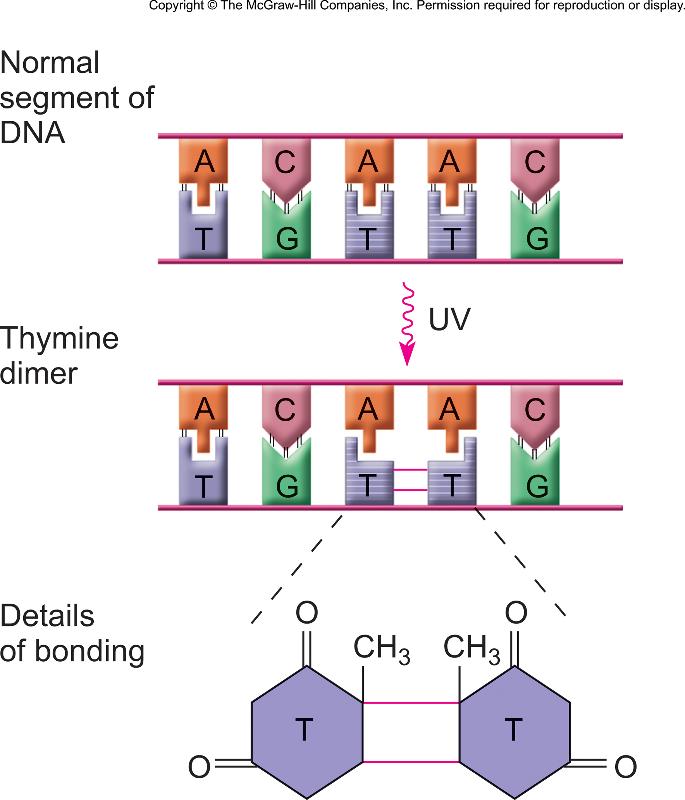
B. Non-ionizing - UV - light - bacteriocidal lamps – micro-benches - sterile rooms --- variety of areas -
1. directly damages DNA due to the production of thymine dimers -
2. Special considerations
a. requires surface --clean and bare - lacks penetration of ionizing irradiation
b. hazards -- burns - vision - carcinogenic potential and microbial resistance
|
|
|
VI. Filtration - generally reserved for fluids that cannot be heat sterilized - (heat labile fluids)
A. Mechanical mech of disinfection - -- size exclusion
|
5.0 um filters exclude fungi, algae and animals 3.0 um filters exclude yeast and unicellular algae 12. um filters exclude protozoa & small circular algae 0.45 um filters exclude most bacteria 0.22 um filters exclude most bacteria & largest viruses 0.025 um filters exclude larger viruses and "pliable" bacteria such as mycoplasmas, rickettsiae, & chlamydias 0.01 um required for the smallest viruses
1. Polycellulose acetate filters - a. Problems - filters are thin, they can absorb small volumes of filtrate, and may tear or clog easily
2. Metallic compound filters 1. heavy metals - irreversibly bind proteins 2. toxic heavy metals may contaminathe the filtrate
|
|
V. Osmotic Pressure - The net movement of wateracross a semipermeable membrane. An ancient method of preserving foods for example salting of meats, the high sugar content of jams and jellies, and some types of pickles
VII . Chemical Methods of Microbial Control
A. Choosing an agent
1. rapid action in low concentration
2. soluble in water or alcohol with long-term stability
3. broad spectrum with low toxicity
4. penetration of inaimate surfaces for long-lasting action
5. not inactivated by organic matter
6. non-corrosive, non-staining
7. sanitizing and deodorizing properties
8, affordable and available
9. nonoffensive odor
B. Halogens - oxidsizing agents - disrupts the 3d folding of protein
1. Chlorine -
a. Sodium hypochlorite - bleach produced by dissolving gaseous Chlorine in water
b. a common household disinfectant - 3/4 cup per gallon of water
c. Residual agent
d. Can be effective against endospores
e. Chloramines - new for water -- better for fish gills less likely damaged
f. Disadvantages of -chlorine
(1)ineffective at alkaline pH
(2)organic matter reduces activity
(3)unstable exposed to light
(4) corrosive to metals
(5) removes colors (oxidizes them)
2.. Iodine
a. antiseptic - tinctures – mixed with alcohol
b. acqueous - surgical scrubs
c. iodophors combined with detergent ( Betadine)
(1)increases penetration
(2)slows release
(3)mild - antiseptics used as vaginal washes - other mucous membranes
3. Fluorine -- water treatment/ toothpaste
a. fluorine incorporates into the enamel of teeth and increases effectiveness with use.
 Show/hide comprehension question...
|
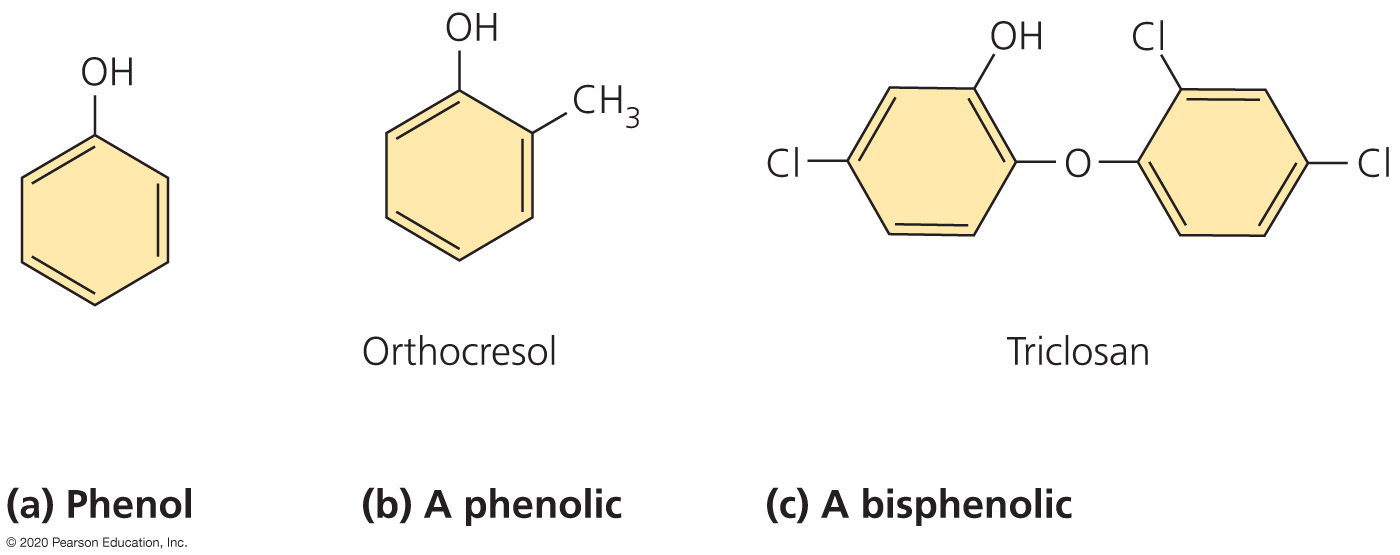
B. Phenolics - an early antiseptic - Lister's - carbolic acid 1. mechanism of kill is two fold a. High concentrations - alkylating agents-- cellular poisons - disrupt cell membranes and precipitate proteins b. Low concentratiom- critical enzyme targets - used as eyedrop preservative
2. Hexachlorophene – combines the action of phenol and deterget a. effective shin disinfectant of 60's
b. incorporates into the skin and increases effectiveness with use c. found to cause brain damage in neonatal animals - banned from the nursery now available by perscription
3. Chlorhexidine - hand scrubs can be be used on neonates
4. Advantages of phenolics – broad spectrum some are sporocidal ` 5. Disadvantages . a. Pure phenol - anaestetic qualities active ingrediant in Chloraseptic b. caustic - Pseudomonas - can use low concentrations as a carbon source
|
|
C. Alcohols - concentrations of 50 - 70% disrupt cell membrane (dissolves lipids) denatures proteins dehydrates
1. Resistance is a major problem especially enveloped viruses such as hepatitis --
|
D. Surfactants -- especially cationic detergent -- quaternary ammonium compounds - 1. Decrease the surface tension of water and solubilize lipids -- cell membrane- 2. Ineffective against TB, hepatitis -Pseudomonas 3. Preservative in eyedrops has caused blindness due to Pseudomonas aeruginosa 4. Low-level clinical disinfectants
|
|
|
|
E. Heavy metals – 1. Examples include: mercurochrome – mercury, copper, arsenic, zinc, silver nitrate 2. mechanism of activity- precipitate and inactivate protein – 3. Problems a. Toxic b. Cause allergic reactions c. Biological fluids depress activity d. Resistance
|
E. Aldehydes
|
1. Polymerize -- fix --- biological molecules -- by crosslinking organic functional grou 2. formerly used a fumigants 3. Advantages Kills TB, Pseudomonas and even spores and viruses 4. Problem - Irritating and carcinogen 5. Gluteraldehyde is better, more pleasant, active in the presence of organics
|